Widget Wheel
Engineering field notes
The development tree
How do you keep a sundial in frame, paint a planet on a phone and give five sites the same sense of time? Follow a branch from the working scene to the measurement behind it.
Last field check
widgetwheel · model workshop
the assembly bench
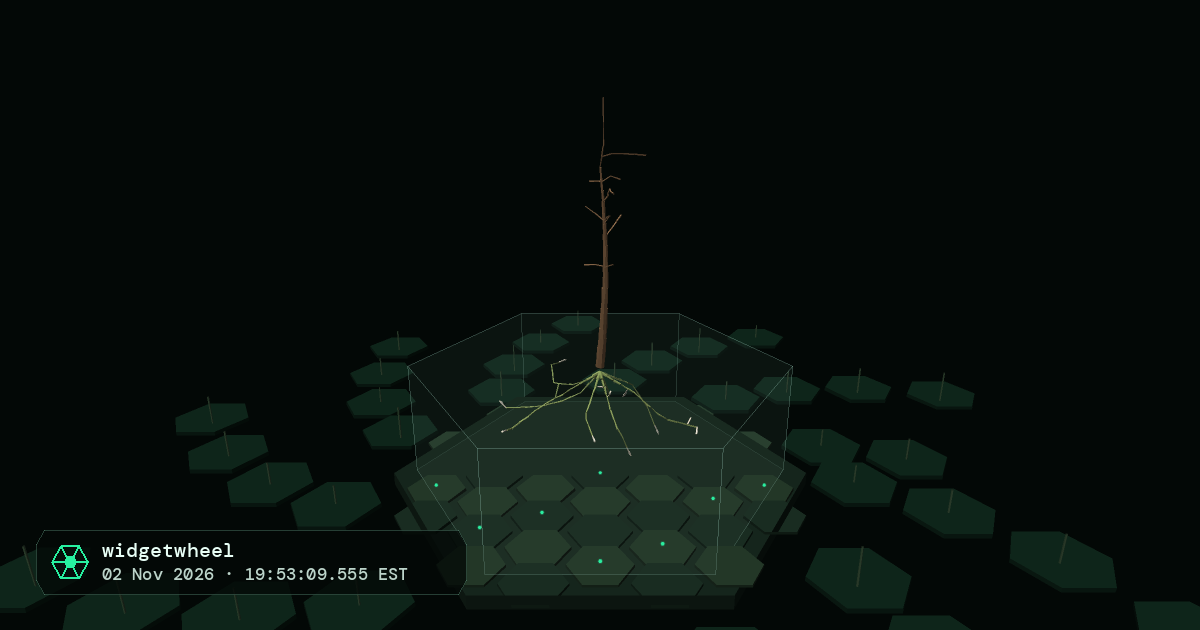
Turn the hourglass, lift apart the tree island or see how the easel stands. The tree and easel are the golf course miniatures of their gallery originals.
Drag to turn. Pinch to zoom, or focus the model and use the wheel. Arrow keys turn, + and − zoom, and Home resets the view. Tap a part to pick it and tap empty space to clear. Tap hologram or laser again to play it again.
view controls
Branch 01 · Geometry
One model, two renderers
-
133 frames
The browser draws the same shapes as the server
Widget Wheel starts with a server-drawn picture. When JavaScript takes over, the polygons still need to line up. The release test compared both lists for the same clock instants.
How it was checked
The M9 parity run compared 16,738 projected polygons across 133 frames. Every frame matched. A separate 95,300 clipping checks tested how shapes cross the camera’s view. These are correctness tests from this release.
-
110.459 mm
Measure the space between the hen and traffic
The moving school bus folds its stop arm. The hen holds her roadway pose. Replaying 720 completed crossings with these shapes left at least 110.459 millimetres between their conservative projected bounds.
How it was checked
The replay compared each movement segment against passing traffic, covering 14,603 vehicle appearances across 1,440 lane windows and 24,877 comparisons. A separate test combined 14 gait-and-direction profiles, two lanes, ten vehicle kinds and two speed extremes. All 560 combinations cleared the allowed arrival window by at least 253.105 ms. The numbers describe simulated world geometry.
Branch 02 · Images
Texture work and share cards
-
43.75% fewer texels
Smaller screens build a smaller planet surface
In Journey to Mars, a canvas narrower than 700 pixels requests a 384 × 192 texture for Earth or Mars. At larger widths it requests 512 × 256. The renderer builds each surface a few rows at a time.
How it was checked
Each compact texture contains 73,728 samples, compared with 131,072 at the larger size. The 57,344-sample reduction is per texture. Pixel counts alone cannot establish frame rate, battery life or a visitor’s download savings.
-
86,652 bytes
Five course marks fit on one WebP sheet
Put Put draws its course signs from one 1,120 × 224 image. The sheet collects the five sites’ established characters and emblems. A small map tells the renderer which rectangle to draw for each host.
How it was checked
The WebP weighs 86,652 bytes. Its separate 270-byte JSON describes five crop rectangles. The image’s SHA-256 fingerprint begins 3f1eb90846fc on all five hosts. The renderer can reuse the same local image as a sign moves through a scene. No frame-rate change was measured.
Branch 03 · Cameras
Where each world puts the eye
-
0.190 px
Check the camera against a projected subject
The rig fits a subject into the part of the screen left clear by the interface. A release test compared its predicted bounds with the projection of 4,000 points.
How it was checked
The archived safe-rectangle sweep covered 194,480 frames. The largest difference between the predicted and sampled bounds was 0.190 pixels. This is a historical geometry measurement. The scene directory below links the opening views available today.
-
4 viewport sizes
Does the original road frame hold across screen shapes?
The Crossing’s frame regression passed all 26 checks. They include placing the sample hen inside its original projected frame at 320 × 640, 390 × 844, 900 × 1,200 and 1,366 × 900.
How it was checked
The 26 original checks exercise the room-camera function, road and lane geometry. A separate run then solved the current shared rig for seven rooms at six viewport sizes and three times. All 126 subject centres stayed inside the space left clear by the default overlays. At 390 × 844 the Crossing’s projected bounds ran from (86, 349) to (304, 567). Both tests measure geometry. Browser controls and frame time require different checks.
Camera directory · 8 rooms
Opening views for eight rooms. Seven also have an archived camera plate from 2 October at 19:00 UTC. The green box shows the chosen subject’s projected position inside a 390 × 844 test viewport. Build times cover one offline geometry build in that frame.
- Sundial
A low opening angle puts the dial against the sky. The read view looks down across the plate.
Dial + style 315.2 × 208.1 px 8.8 ms geometry build - Widget Tree
The subject shifts with the chosen part of the island. Leaf, root and soil each have a framing preset.
Tree 100 × 293 px 13.2 ms geometry build - House
The opening frame places the building plot below centre. The lines view tilts down to expose its layout.
Staked footprint 356 × 110.8 px 1.4 ms geometry build - Deep Carbon
The camera centres on the seam’s subject. Close and overhead views change its scale and viewing angle.
Coal lump 206.9 × 213.7 px 18.7 ms geometry build - Crossing
A following camera tracks the subject along the road. A wider view leaves room for its surroundings.
Hen 10.4 × 13.6 px 15.8 ms geometry build - Three-Year Painting
The rig anchors on the canvas. Separate close and garden views frame the painting and its surroundings.
Canvas 321.8 × 233.4 px 3.2 ms geometry build - Hourglass
The rig keeps space clear for the controls. Its detail view targets a smaller region around the glass.
No October camera plate on file. - Journey to Mars
A dedicated navigation camera clamps its position for each scene as the view moves between Earth, the mission and Mars.
Ship marker 28 × 28 px
Branch 04 · Shared clock
What travels between sites
-
1 style group
The dog galleries’ first-paint technique comes to the wheel
Widget Wheel adopted the dogs’ WordPress style-loading technique. Its loader resolves eligible theme sheets in dependency order, compacts them and places them together in the page head.
How it was checked
The Widget Wheel loader records the original dog-theme module and source fingerprint. Its public output is a style element named ww-inline. A sheet with a document-relative URL keeps its own link so its image paths still resolve.
-
20 holes · 5 hosts
One scorecard crosses five websites
Each site owns four holes. In a played round, a single putt at 35% power sank Buffer Gate on Doxfeed. Next opened Polar Orbit on Snowroach as hole two, with the first result still on the scorecard.
How it was checked
A separate deterministic test completed 10,270 itineraries. Each started with a local hole, visited twenty unique holes and changed sites between turns. Another 4,000 checkpoint encodes and decodes retained the expected state. These are test runs. The Buffer Gate handoff was played in a browser.
-
15 exhibit routes
One source record can serve several readers
Doxfeed’s exhibit readers share a release manifest and an index of individually analyzed statements. A statement can appear in several exhibits with the same source link. DoxéDex also offers a separate search of the retained archive.
How it was checked
This release lists 15 exhibit routes and 511 exhibit placements for 403 distinct analyzed statements. The release index pins the corresponding statement packs. These figures describe the published selection on this date.